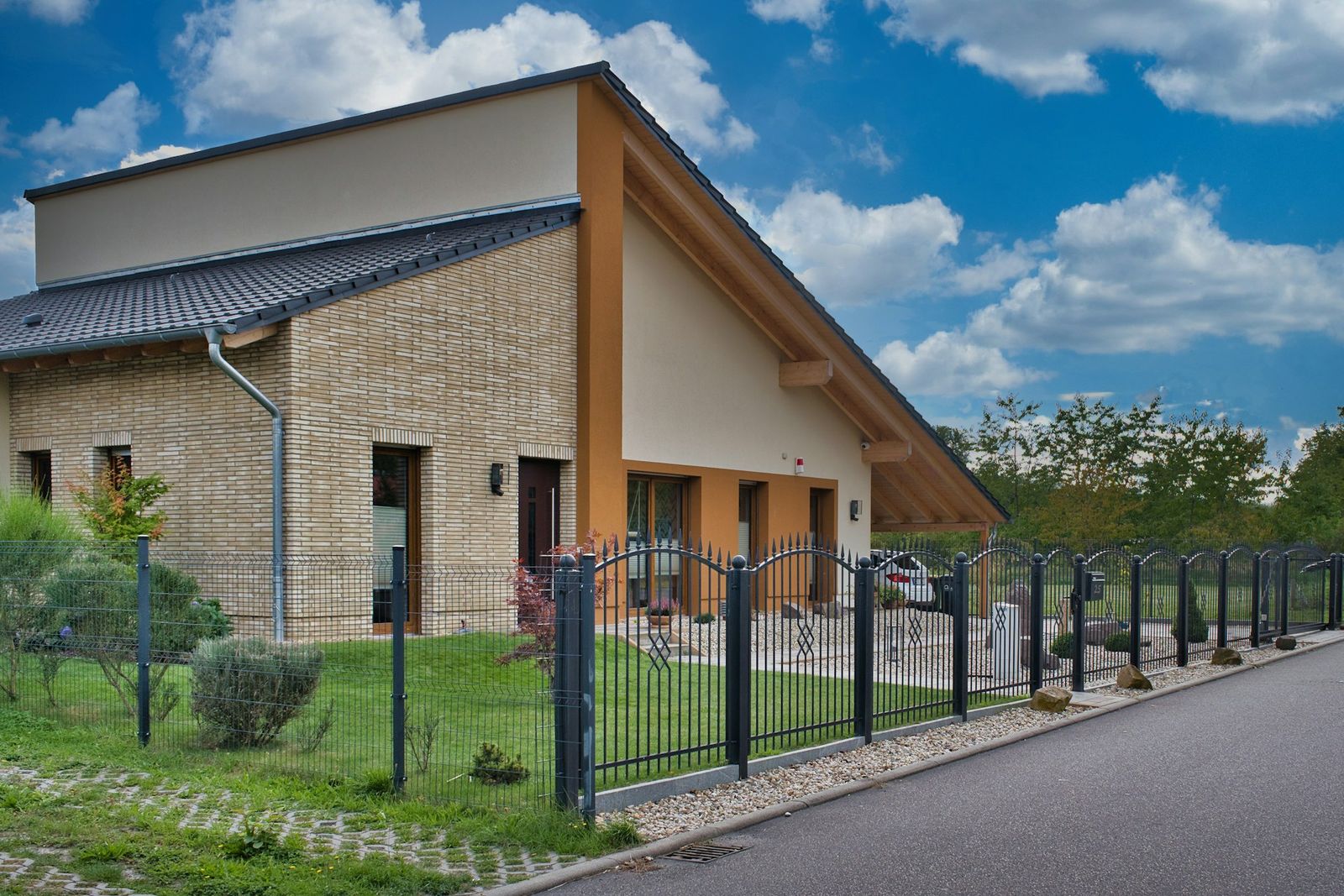
Decide first whether you need to block the view or only mark the line. Privacy here means a solid face against hard wind, so more of the job is in the ground. If a boundary is enough, iron or chain link gives the wind far less to push on.
What the city's own paperwork shows
We found no count of what fences El Paso homes have, so we will not tell you what is most common. The city's documents do show what it expects to see. A 2016 zoning amendment defines a masonry wall as a barrier "constructed primarily of any combination of durable rock, brick or concrete" that "may include decorative elements of wrought-iron" (the copy we read is the draft on the council agenda, so check the adopted wording). The historic district guidelines name "Rock, brick, wood and wrought iron" as acceptable materials. The permit sheet singles out masonry and chain link.
The types side by side
| Type | Against wind | What city papers say | Ask the company |
|---|---|---|---|
| Block or rock wall | Solid face. The footing and steel do the holding. | Permit if over 42 inches. In historic districts, rock is acceptable and cinder block is not appropriate. | Footing size, steel, cap, and the wind load the design assumes. |
| Block base with iron on top | Solid below, open above. | The draft definition lets a masonry wall include wrought iron. | Does the 42 inch line count the iron? Ask the city, then get it in writing. |
| Wrought iron | Open. The post bases carry the load. | Not named on the permit sheet. Acceptable in historic districts. | How posts are set, what finish goes on, and what upkeep it needs. |
| Chain link | Open, until you add privacy slats and close it up. | Permit if over 6 feet. Not appropriate in historic districts. | Post depth and top rail, and whether slats change the design. |
| Wood | Solid if boards touch, less so if they are spaced. | Not named on the permit sheet. Acceptable in historic districts, case by case. | What the posts are made of and how they are set. |
| Vinyl | Usually solid panels. | Not named on the permit sheet or in the historic guidelines' list. | What wind the panels are rated for, and a job here you can go look at. |
"Not named" does not mean "no permit". The same sheet says a permit is required to construct or repair a structure. Ask the city about your material.
Sun and heat
The weather service and UTEP paper says El Paso averages some 84 percent of possible sunshine a year, and puts its solar radiation near the maximum for the Western Hemisphere. The weather service counts an average of 26 days a year at 100 degrees or more for 1991 to 2020, a record 70 in 2023, and a run of 44 straight days from June 16 to July 29 that year.
We looked and found no El Paso study of how wood, vinyl or paint hold up under that, so we will not give you a number of years. Ask each company for a fence of the same material it put in here at least five years ago, and go look at it.
Dust and gates
The same paper counts an average of 14.5 significant dust events a year, and a 42 percent chance of blowing dust on any single day in March, April and May. If you are choosing a rolling or automatic gate, ask how the track and opener cope with that, and what cleaning they need.
Where you live changes the answer
- East of the Franklin Mountains near Transmountain. The mountains split the city in two, and the paper says wind coming out of the gap can run about 50 percent stronger. A tall board fence has more to prove here.
- The east side. The 2009 storm gusted to near 80 mph over the eastern part of the city. One storm is not a pattern, but it is worth saying where you are when you ask for a quote.
- A historic district. Austin Terrace, Chihuahuita, Downtown, Magoffin, Manhattan Heights, Mission Trail, Old San Francisco, Sunset Heights and Ysleta are locally designated. Material and height get reviewed.
- A corner lot. Height near the corner is a safety question. See the city rules page.
- An owners' association. Texas law says it generally cannot stop a perimeter fence as a security measure but can regulate the type of fencing. Read your rules before you pick.
- Low ground or near an arroyo. A solid wall can block water. El Paso Water says flooding occurs when runoff exceeds what an arroyo or channel can carry. See the block wall page.
When to build
We found no source that names a best month, and each season has its catch.
- February through May: wind and dust, and the air is at its driest, with average humidity of 28 percent in the spring dust season against 42 percent over the year.
- June and July: the first 100 degree day comes on June 12 on average, and most of them fall in these two months. The block industry note calls 40 to 90 degrees normal and, above that, talks about keeping materials cool and in shade, mixing small batches and keeping mortar from losing water.
- July to mid-September: the monsoon brings about half the year's rain, in bursts.
Ask how the company handles pouring concrete or laying block on a day like that.
Phone line opening soon
Allow us to connect you to a local pro.
Sources
- City of El Paso, council agenda item, public hearing January 12, 2016: draft ordinance defining masonry wall and amending Section 20.16.020, Mandatory Walls (PDF, scanned)
- City of El Paso, Design Guidelines for El Paso's Historic Districts, Sites, and Properties (PDF, no date on it)
- City of El Paso Planning and Inspections, When Do I Need a Permit? (one page PDF, no date on it)
- Concrete Masonry and Hardscapes Association, TEK 14-16B, Concrete Masonry Fence Design (trade body note, based on the 2003 and 2006 building codes)
- National Weather Service and University of Texas at El Paso authors, A Synoptic Climatology of Blowing Dust Events in El Paso, Texas from 1932-2005 (PDF, about 2006)
- National Weather Service El Paso, 100 degree days at El Paso (page updated December 2, 2024)
- National Weather Service El Paso, report on the December 8, 2009 wind storm (PDF)
- City of El Paso Planning and Design, Historic Preservation
- Texas Property Code, section 202.023 (free copy on Public.Law)
- El Paso Water, Stormwater FAQ
- Concrete Masonry and Hardscapes Association, TEK 03-01C, All-Weather Concrete Masonry Construction (trade body note)
Read on 2026-11-05. External pages can change.